Newsletter Block
This newsletter signup form needs a storage option. Edit the block and enter a storage location via the Storage tab.
All in Reviews
Shortly before opening, Paris Noir became mired in controversy when Guadeloupean curator Chris Cyrille accused the show’s lead curator, Alicia Knock, of appropriating his curatorial concept and research. His Instagram post sparked debate over Knock’s role as a white curator of France’s largest exhibition of Black art to date, conceived as responding to shared experiences of colonisation and the Middle Passage. Other historians and curators subsequently waded in. These tensions reflect both the difficulty of staging such an exhibition in a country that treats racial identity as a deviation from the civic norm – a framing that renders projects like Paris Noir at once exceptional and suspect – and the persistent entanglement of identity politics and individualism in an otherwise noble effort to present a fuller, more accurate history of globalised art: one in which Paris represents an important hub.
Artemisia’s story offers revealing clues not only with regard to the past but to the contradictions of the present. The exhibition reflects both a cultural hunger for feminist recovery and an art market eager to capitalize on narratives of resistance and rediscovery. Yet it raises a pressing question: can a private institution like the Jacquemart-André, steeped in bourgeois refinement, do justice to a figure as uncompromising as Artemisia? Does displaying her work in plush interiors aestheticize her trauma, blunt her sharp edges? The tension between institutional politeness and feminist rage hums faintly, just beneath the surface. Artemisia’s legacy lies not merely in her biography or technical mastery, but in her confrontational refusal to flinch.
At the far end of the Grand Locos, a former train-repair depot-cum-main-exhibition-site for the 17th Lyon Biennale, there is a vast dark space. It takes your eyes a moment to adjust, but through the darkness you rapidly perceive a series of eight video screens, hung in a spiral formation, illuminating the space with an orange glow like fires in a cave. On each screen a person, holding aloft a flashlight, which illuminates the stalactites and the cave paintings that surround them. The figures begin to hum and trill different notes into the echoing chasm. Suddenly, a chord is struck, and the vibrations of their voices begin to fill the space like warm air. One by one, the filmed subjects sing. Different songs, different voices, different languages coalescing and harmonizing in a chorus that overwhelms you with waves of sound. You move through the space, spellbound by this sonorous butterfly garden. The notes flutter their little wings, enveloping you with something strange but familiar.
Arte Povera responded directly to Italy’s postwar economic boom, aided by the US Marshall Plan. During that time, northern cities like Turin and Milan industrialized rapidly, leading to mass migration from the south. By the late 1960s, Cold War tensions were escalating, and the Italian Communist Party was gaining significant political influence, earning 12.6 million votes in the 1976 general election. During these “Years of Lead” (late 1960s–late ’80s), terrorist paramilitary groups—some covertly supported by the NATO project Gladio—battled police, bombed train stations, and even murdered the Christian Democrat President Aldo Moro.
The 17th Lyon Biennale kicked off at the end of September to great pomp. As guest curator Alexia Fabre announced to a crowd of journalists, this year’s edition is informed by ideas of personal relations, altruism and welcoming the other – vague but not irrelevant topics given how close France came to electing the far-right National Rally Party in July of this year.
Among the most memorable works in the Grandes Locos – a former train-repair depot which serves as the biennial’s main site – is Gözde İlkin’s The Majority of Accent (2018–24), a mixed-media work in which the artist’s characteristic biomorphic figures are painted and embroidered onto the surface of a large textile print of a quarry. The work evokes the venue’s industrial past via images of labour organizing, accompanied by recorded interviews with former workers emitted from speakers hidden in printed, painted and embroidered sacks.
Galindo’s videos and photographs document performances in which she positioned herself in scenes of staged precarity and abuse as a way of representing violence against women in her native country. The works on display range from somewhat absurd images – La Sombra (The Shadow, 2017), for instance, in which the subject runs towards the camera as a tank rolls behind her – to the less graphic but more disturbing video-performance La Verdad (The Truth, 2013). In this piece, Galindo reads aloud first-hand accounts of rape and genocide during the 36-year Guatemalan Civil War. La Verdad is punctuated by the intervention of a dentist, who periodically injects local anaesthetic into her mouth, causing her speech to slur. It is the most potent work in the show for the way that it stages and dramatizes a history of physical and sexual violence and for its allusion to ongoing forms of government censorship, obfuscation and forgetting. In works such as a still from the video of the performance Piel (Skin, 2001), the artist utilizes her naked body as a conduit for articulating the reification of women. However, La Verdad feels more impactful because it is the only piece in the exhibition where the brutalized women speak. Even if the viewer cannot see their faces nor knows their names, Galindo’s ventriloquizing of her own voice to bear witness for these women’s suffering offers them agency and presence in a way that the other works do not.
Cet été, Zero to Infinity, sculpture participative de Rasheed Araeen, a transformé le Turbine Hall de la Tate Modern : “Ce qui n’était au départ que 400 cubes disposés dans un carré est aujourd’hui une structure en perpétuelle évolution”, comme le dit le musée. Araeen est un des pionniers de la sculpture minimaliste au Royaume-Uni, mais un minimalisme que l’on peut exceptionnellement toucher. Retour sur l’histoire d’une œuvre au long cours.
Vojtěch Kovařík’s exhibition ‘The Labours of Hercules’ at Mendes Wood DM tells the story of one of art history’s most frequently illustrated iconographical subjects. Although the title alludes to the 12 tasks carried out by the classical hero Hercules as penitence for having killed his wife and children – after his stepmother, Hera, turned him temporarily insane – only one of the 12 paintings on display directly references its subject (Hercules Dips his Arrows in the Hydra’s Poisonous Black Blood, all works 2023). In marked contrast to the exalted attitudes of most representations of the scene, Kovařík does not depict Hercules triumphantly in medias res. Rather, the viewer is treated to a quiet, even melancholic portrayal. The massive, marble-white figure of Hercules is almost too big to be contained within the picture frame, and there is a look of forlorn concentration on the hero’s face.
Art Brussels is a fair much like the city it occupies. Perhaps not as iconic or flashy as Paris, New York, or London, Brussels is, nonetheless, a plucky, punchy European capital that refuses to be passed over or cede its cultural centrality to the European art world.
Two years after the pandemic forced the 55-year-old fair to adopt a clumsy hybrid of online sales and a city-wide gallery crawl, Art Brussels has triumphantly returned to Brussels Expo, also known as the Palace of Exhibitions—an imposing, almost Stalinist, Art Deco tower perched upon the Heysel Plateau, on the northern outskirts of the city. From its sprawling terraced emmarchement, visitors on the doorstep of the fair can look back upon a sweeping vista of the verdant surrounding park with the city’s iconic Atomium looming large in the distance.
The fact that this impressive setting is quickly put out of a visitor’s mind is a testament to the quality and vitality of the works on display inside. This year’s edition presents 152 galleries from 32 countries with more than 800 artists on display. Booths are divided into five unequally sized sections: Prime, Solo, Discovery, Rediscovery, and Artistic Project.
Le film Toute la beauté et le sang versé de Laura Poitras s’ouvre sur un petit groupe de militantes agglutinées sur le trottoir près du Metropolitan Museum of Art (Met) de New York. Un complot est en train de se nouer. Ensuite, des images de l’intérieur du Met. La caméra fait un panoramique sur l’enseigne de l’aile où se trouve la collection égyptienne : l’aile Sackler, ces méga-mécènes du monde de l’art qui ont fait fortune dans la fabrication d’opioïdes hyper addictifs. Les gardiens renvoient des regards méfiants. Puis quelqu’un se met à crier : “Honte à Sackler”. Les autres se joignent à lui comme un chœur grec. Les vestes tombent au sol, révélant des t-shirts ornés des initiales “P.A.I.N” (Painkiller Addiction Intervention Now). Des flacons de pilules oranges sont jetés en l’air et dans le bassin autour du temple d’Isis de Dendur. Alors que les gardiens tentent frénétiquement d’arracher les banderoles, les activistes mettent en scène un die-in – simulant la mort. À la fois performance et manifestation, ils tombent au sol, mous et immobiles, à l’exception de leur chant continu.
Cerith Wyn Evans is the type of artist whose engagement with the forms and figures of modern art makes his work a joy to look at – especially for those able to untangle its dense web of references. For his most recent exhibition, ‘no realm of thought…’ at Marian Goodman, Paris – one of a two-part exhibition happening concurrently at the gallery in New York – Evans converses with the likes of Marcel Duchamp, Félix Guattari, Frank Stella and David Tudor.
Indeed, rather than two sections divided by a wall – an unfortunate Cold War metaphor if ever there was one – the exhibition could be viewed as an expansive survey, a growing family or an inventory of universal humanism. There is something about the way that Neel depicts bodies – often fat, flaccid and wrinkled, circumscribed with heavy black contours and modelled with undulating impasto brushstrokes – which almost seems to caress their flickering forms into being. Her fearless and loving approach to rendering the human figure in all of its beauty, ugliness and diversity speaks to Neel’s warmth, love and openness towards others. To that end, Pompidou’s mezzanine-level gallery is perfect for this small, dense retrospective. Connected to the pedestrian streets outside by floor-to-ceiling windows, this space gives visitors the impression of being, like Neel’s painting, among and with the masses of humankind.
‘Friends, comrades, this is Rádio Voz da Liberdade, on behalf of the Patriotic Front for National Liberation …’ The voice of Portuguese communist broadcaster Stella Piteira Santos echoes up from the lower level of the Regional Contemporary Art Fund (FRAC) in Marseille. The space is currently host to Ângela Ferreira’s ‘Rádio Voz da Liberdade’, the Portuguese artist’s homage to the guerrilla radio station broadcast in Algeria from 1962 to 1974 by exiled Portuguese dissidents of António de Oliveira Salazar’s dictatorship.
Grains' encourages viewers to cherish the beauty of nature, but its case for biodiversity is only superficial.
‘Double Bind’, Max Pinckers’s first museum retrospective, at FOMU Photo Museum Antwerp, presents five of the Belgian artist’s projects from the past half-decade. Each embodies his critical stance on the truth claims of photography, an approach that Pinckers terms ‘Speculative Documentary’. Conceived with fellow artists Thomas Bellinck, Michiel De Cleene and An van. Dienderen (a grouping that refer to themselves as The School of Speculative Documentary), the theory seeks to problematize various documentary formats – from photography and film to theatre and performance – blurring the line between reality and fiction.
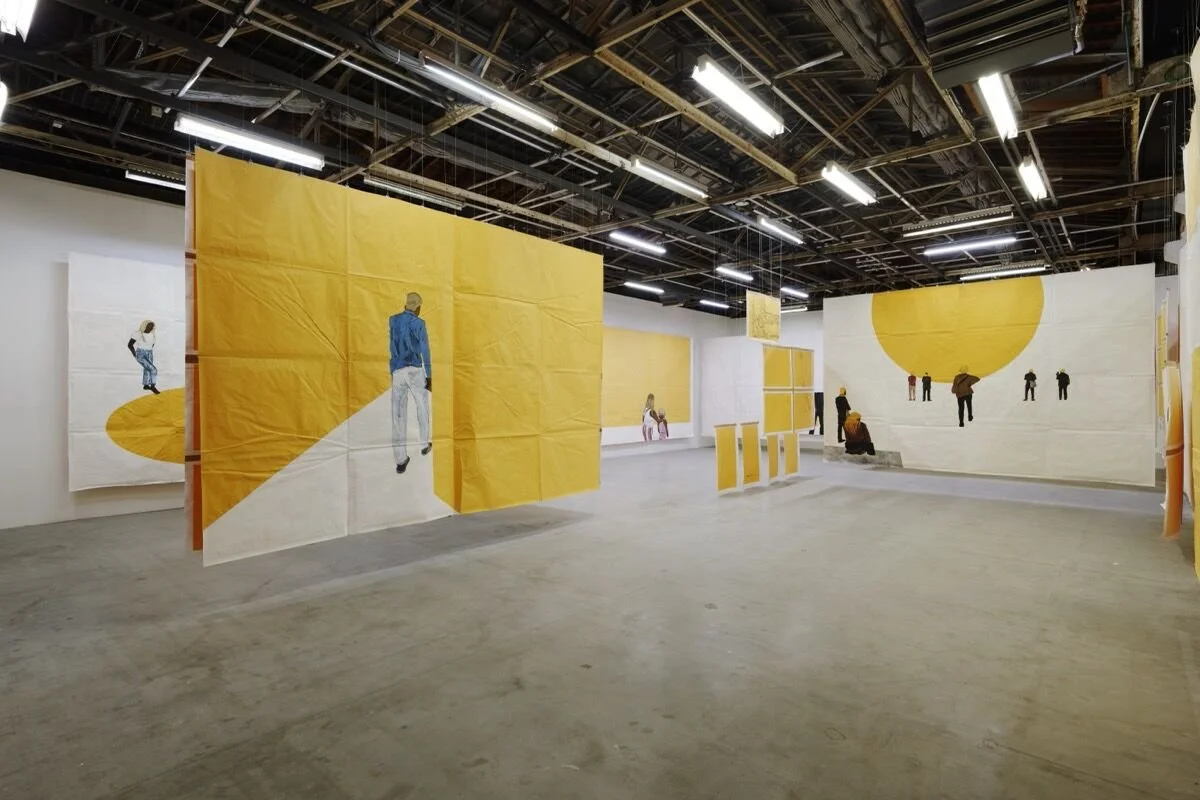
Maxwell Alexandre’s exhibition “New Power,” currently on view at the Palais de Tokyo in Paris through March 20th, was inspired in part by the 2018 music video for “Apeshit” by Beyoncé and Jay-Z. The hip-hop couple’s triumphant traipsing through Europe’s most famous museum, the Louvre, reignited conversations about the sociology of museum visitors; the value and accessibility of culture; and above all, the tension between the museum’s pretentions of being a democratizing, educational space despite the troubled histories of colonialism and plunder that had built up its collections. The global resurgence of racism and xenophobia, exemplifed by the presidencies of Donald Trump in the United States and Jair Bolsonaro in Brazil, seemed to lend these concerns additional urgency.